
← All festivals

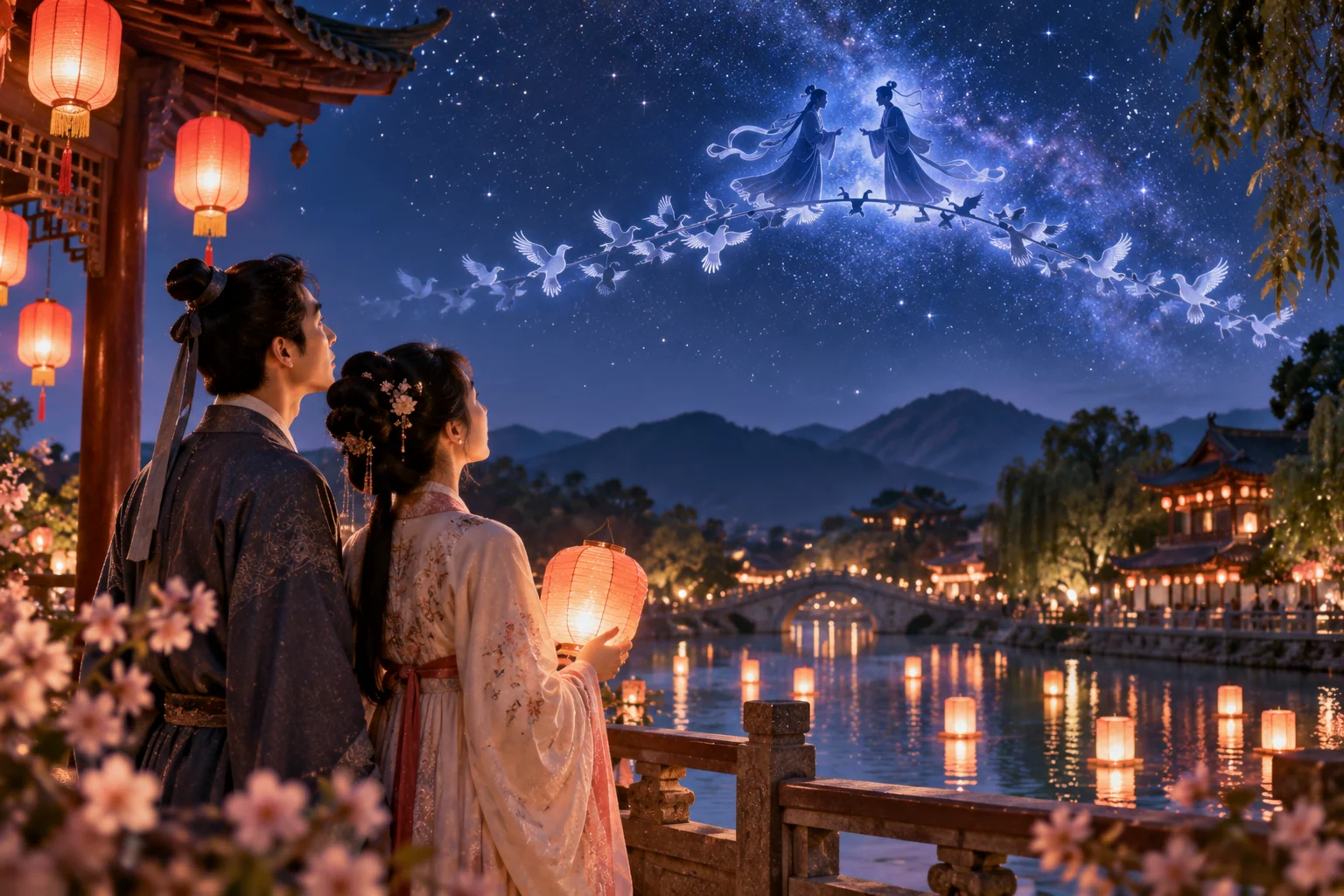
The lunar seventh of the seventh, when the weaver girl and the cowherd — Vega and Altair — are allowed across the Milky Way to meet. China's own lovers' day, older than the Valentine's it now competes with, and the same story Japan keeps as Tanabata.

When it falls

The seventh day of the seventh lunar month, in August. The Japanese Tanabata is the same festival moved to 7 July on the Gregorian calendar.

The Phala almanac gives the exact day for your own city; the lunar and solar rules above are what it computes from.

The story

Zhīnǚ the weaver girl, seventh daughter of the Jade Emperor, came down to bathe and a cowherd took her clothes. She married him and they had two children, and when heaven found out she was taken back and the Milky Way was drawn across the sky between them.

The magpies took pity and make a bridge of themselves one night a year. The two stars are Vega and Altair, and the river between them is the galaxy; if it rains on the night, that is the two of them crying.

It was for most of its history a festival of the girls rather than of couples — a night to demonstrate needlework and ask for skill in it. The lovers' reading is what has survived into the shops.

How the day is kept

  • Threading a needle by moonlight, or by the light of a single incense stick, to show a steady hand — the older custom, still kept in places.
  • Offerings of fruit, flowers and tea to Zhīnǚ, made by young women asking for skill and a good match.
  • Flowers, chocolate and dinner, which is the modern version and now competes with 14 February in Chinese cities.
  • Korea keeps the same night as Chilseok, at the end of the rainy season, and eats wheat noodles and pancakes before the cold spoils the grain.

More family bonds

The Phala almanac shows this day where it falls for your own city — sunrise, tithi and all five limbs, anywhere on earth. See how the almanac works →