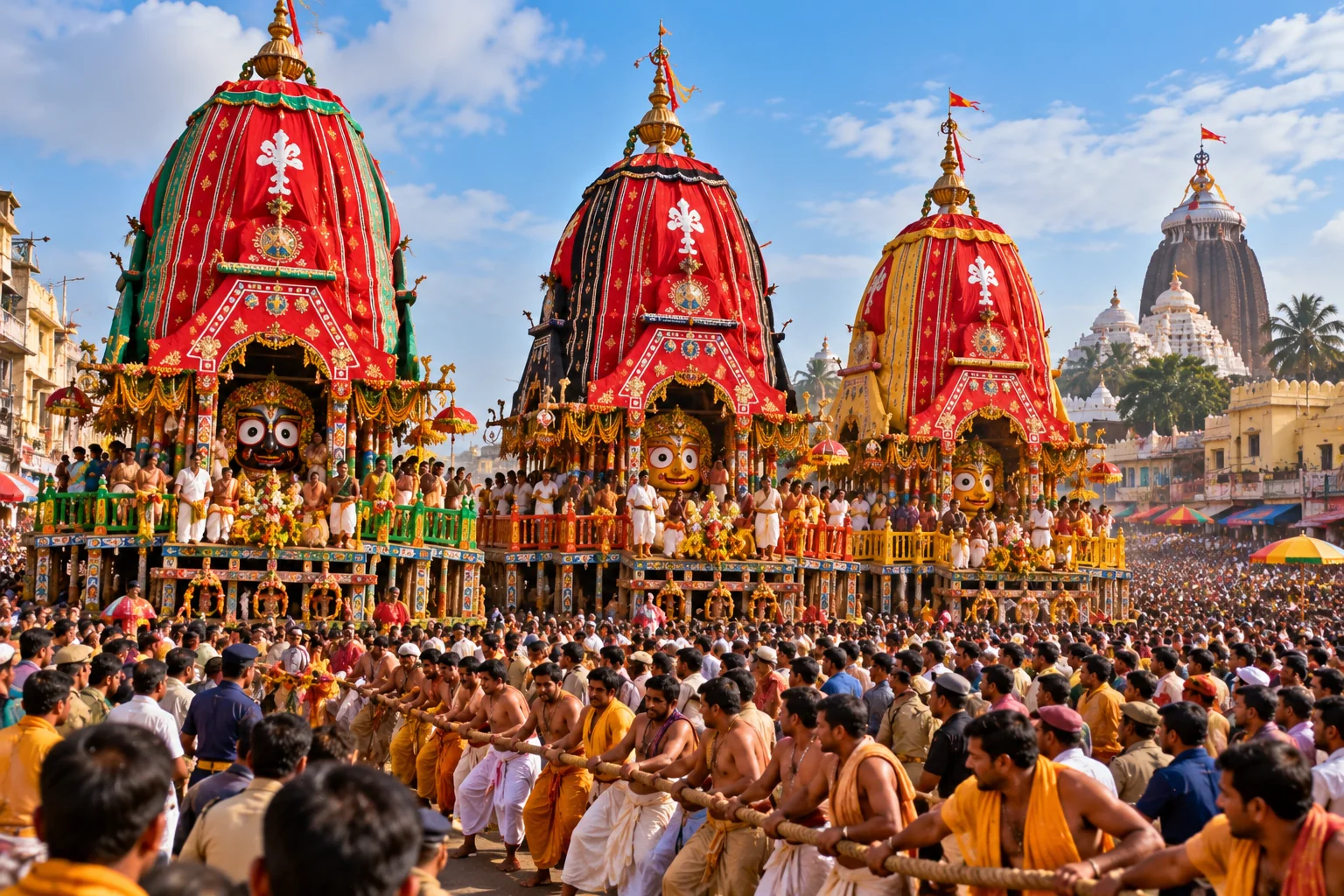
Jagannātha, Balabhadra and Subhadrā leave the Puri temple on the second day of Āṣāḍha and are pulled through the city on three timber chariots. The one day of the year the deities are met in the open street rather than the sanctum.
How Vedic Phala finds the date
Purī’s Ratha Yātrā begins on Āṣāḍha śukla dvitīyā, the second tithi of the waxing fortnight. Vedic Phala derives the lunar month and tithi from the local pañcāṅga rather than assigning a fixed June or July date. A tithi can start after sunrise or cross midnight, so the civil date follows the local lunar boundary. The Purī temple administration remains the authority for the procession programme itself.
The date opens a larger sequence. The deities have already left public view during Anavasara after Snāna Yātrā; on dvitīyā they travel to the Guṇḍicā temple, remain there, and return in the Bahudā Yātrā. The three chariots are rebuilt every year from specified timber and are not generic parade floats. Their names, colours and number of wheels belong to Jagannātha, Balabhadra and Subhadrā individually.
Cities around the world now hold local ratha processions, sometimes on the nearest weekend. Those gatherings preserve the public encounter with the deities but may not share Purī’s exact civil date. The app marks the traditional lunar opening; local event organisers supply the practical procession date.
The story
Jagannātha, lord of the world, is Kṛṣṇa in the form Puri worships: a wooden figure with round eyes and stumps for arms, beside his brother Balabhadra and his sister Subhadrā. Once a year the three leave the sanctum and are pulled two miles down the Grand Road to the Guṇḍicā temple, where they stay a week before returning.
The reason given is that Subhadrā asked to see the city, and her brothers took her. Another telling makes the Guṇḍicā temple the aunt's house, and the journey a family visit.
The point of the day is access. A temple that admits only Hindus puts its deities in the open street, where anyone at all may see them and pull the rope. The English word juggernaut comes from the chariots and the crowds that surrounded them, and is a traveller's misreading of the day rather than a description of it.