← All festivalsMawlid an-Nabī

The birth of the Prophet Muḥammad, on the twelfth of Rabīʿ al-Awwal. Kept with recitation of his life and, in South Asia, night-long assemblies and shared food; some traditions do not observe it.

When it falls

The twelfth of Rabīʿ al-Awwal, the third month of the Islamic year. Shīʿa tradition keeps it on the seventeenth. The Islamic calendar is lunar, so the date walks the Gregorian year.

The Phala almanac gives the exact day for your own city; the lunar and solar rules above are what it computes from.

The story

Muḥammad was born at Mecca in about 570, in the Year of the Elephant. He was orphaned young, worked the caravan routes, married Khadīja, and at forty received the first revelation in a cave outside the city.

The day was not kept in the first centuries of Islam. It became a public festival under the Fāṭimids in Egypt and spread from there, and the great celebration at Erbil in the thirteenth century is the one the chroniclers describe.

Whether to keep it at all is an old and open argument. Much of the Sunni world and the Shīʿa world observe it; Salafi scholarship and Saudi Arabia hold that a festival the Prophet did not keep should not be added, and the day is not marked there. Stating that is more honest than presenting one side as the practice.

How the day is kept

  • The Prophet's life is recited — the mawlid poems, the Burda of al-Būṣīrī, and in South Asia the naʿt, sung praise in Urdu and Persian.
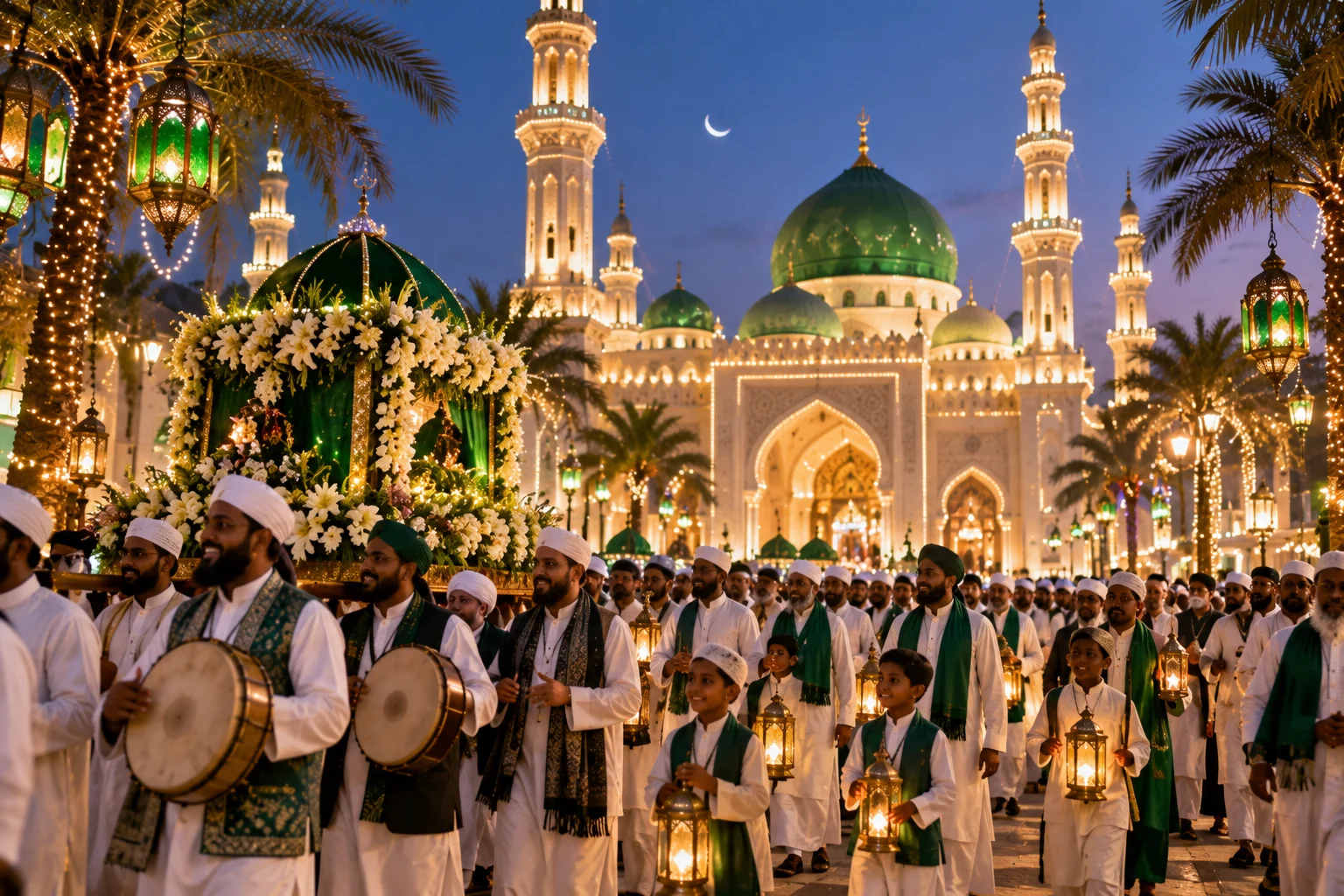
  • Streets and mosques are strung with lights and green flags; processions in India, Pakistan and Indonesia carry banners through the night.
  • Food is cooked and given away, and the day is one for charity and for feeding the poor.
  • It is a public holiday in most Muslim-majority countries, and in India, where it is called Barawafāt or Milād-un-Nabī.
  • In Sufi orders the night is a dhikr, a gathering of remembrance, rather than a procession.

More birthdays of gods, saints and teachers

The Phala almanac shows this day where it falls for your own city — sunrise, tithi and all five limbs, anywhere on earth. See how the almanac works →