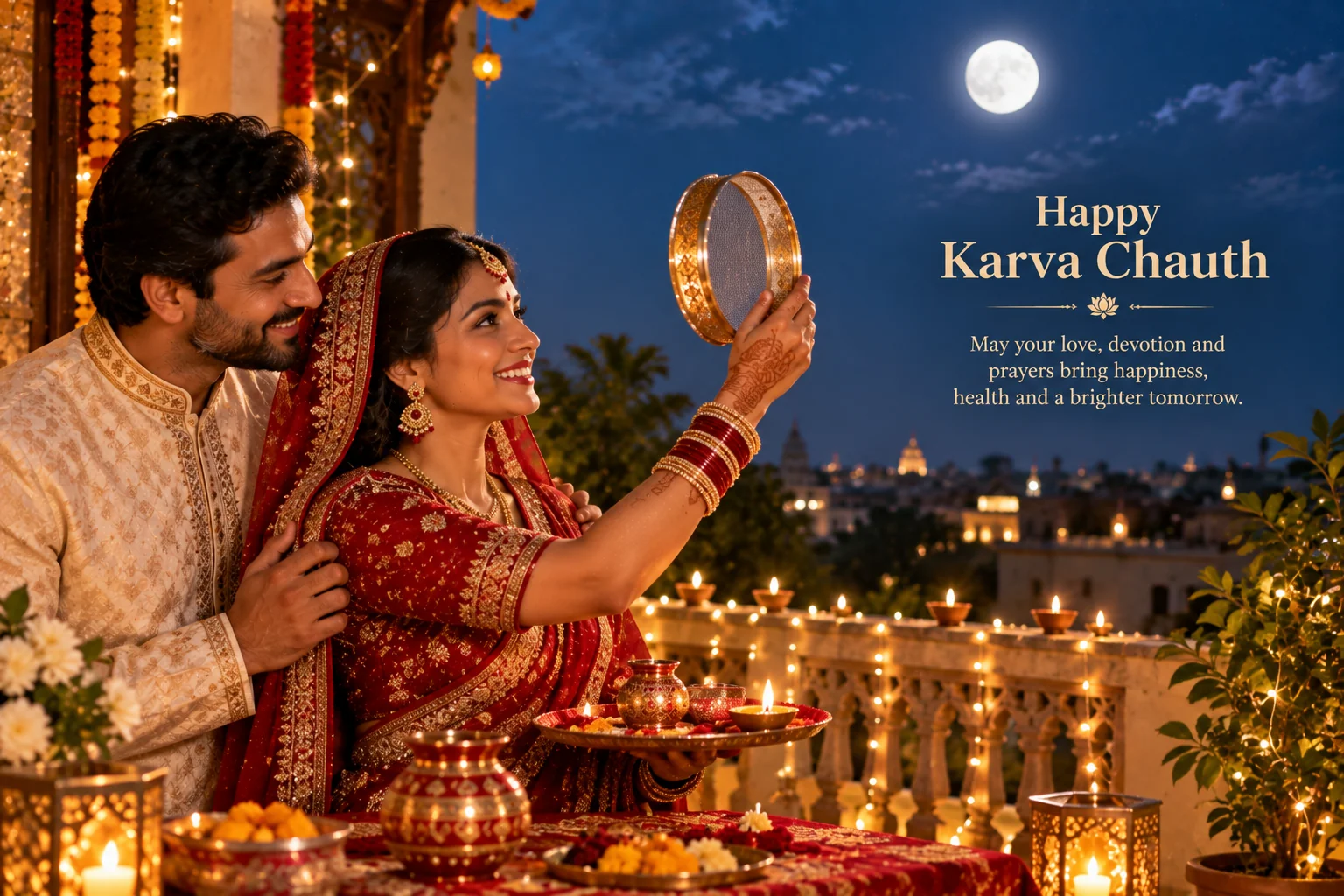
A fast kept by married women from sunrise until moonrise, broken on seeing the moon through a sieve and then the husband's face.
When it falls
The fourth lunar day (caturthī) of the dark half of Kārttika (Āśvina by the southern count), about nine days before Dīpāvali, in October or November. The fast ends at moonrise, which the almanac gives for each city.
The Phala almanac gives the exact day for your own city; the lunar and solar rules above are what it computes from.
How Vedic Phala finds the date
Karva Chauth is observed on the fourth tithi of the waning half of the autumn month, commonly named Kārttika in the north and Āśvayuja in the app’s amānta reckoning. Vedic Phala computes kṛṣṇa caturthī at local sunrise. The different month labels describe the same lunar cycle under two month-ending conventions; they do not necessarily indicate different festival dates.
The fast is broken only after the Moon is seen, which makes the reader’s city essential. Moonrise varies substantially across a country and even more across continents. A Delhi moonrise copied into a London or California schedule is unusable even when the civil date happens to match. Weather can prevent direct sighting, and families then follow their customary rule or a trusted local almanac rather than waiting on a generic website timer.
Sargī before dawn, the evening story and the sieve-viewing rite belong to north Indian family practice, with local variations in Punjab, Rajasthan and Uttar Pradesh. The app’s festival date identifies caturthī; a complete observance still needs that day’s local moonrise and the family’s own convention.
The pre-dawn meal is traditionally sent or prepared within the husband’s family, and groups of women gather in the evening to pass decorated karvas while hearing the vrata story. Contemporary households may reinterpret or share the fast, but the site describes the established women’s observance without turning a modern choice into an ancient calendar rule.
The story
Karvā is the clay pot with a spout that the women exchange, and cauth the fourth day. The fast is kept by married women for their husbands' long life, and it is the festival of the north-west: Punjab, Haryana, Rajasthan, Delhi and the western Uttar Pradesh.
The story told at the pūjā is Queen Vīrāvatī's. Weak with hunger, she was tricked by her seven brothers with a mirror in a tree into thinking the moon had risen, broke her fast, and her husband died at once; she kept the fast again in full and he was restored. The fast is not to be broken before the true moon.
The day may have begun as the women's day before the men went to war, or as the friendship day on which a new bride chose a sister-friend in her husband's village; both readings survive in the customs.