← All festivals

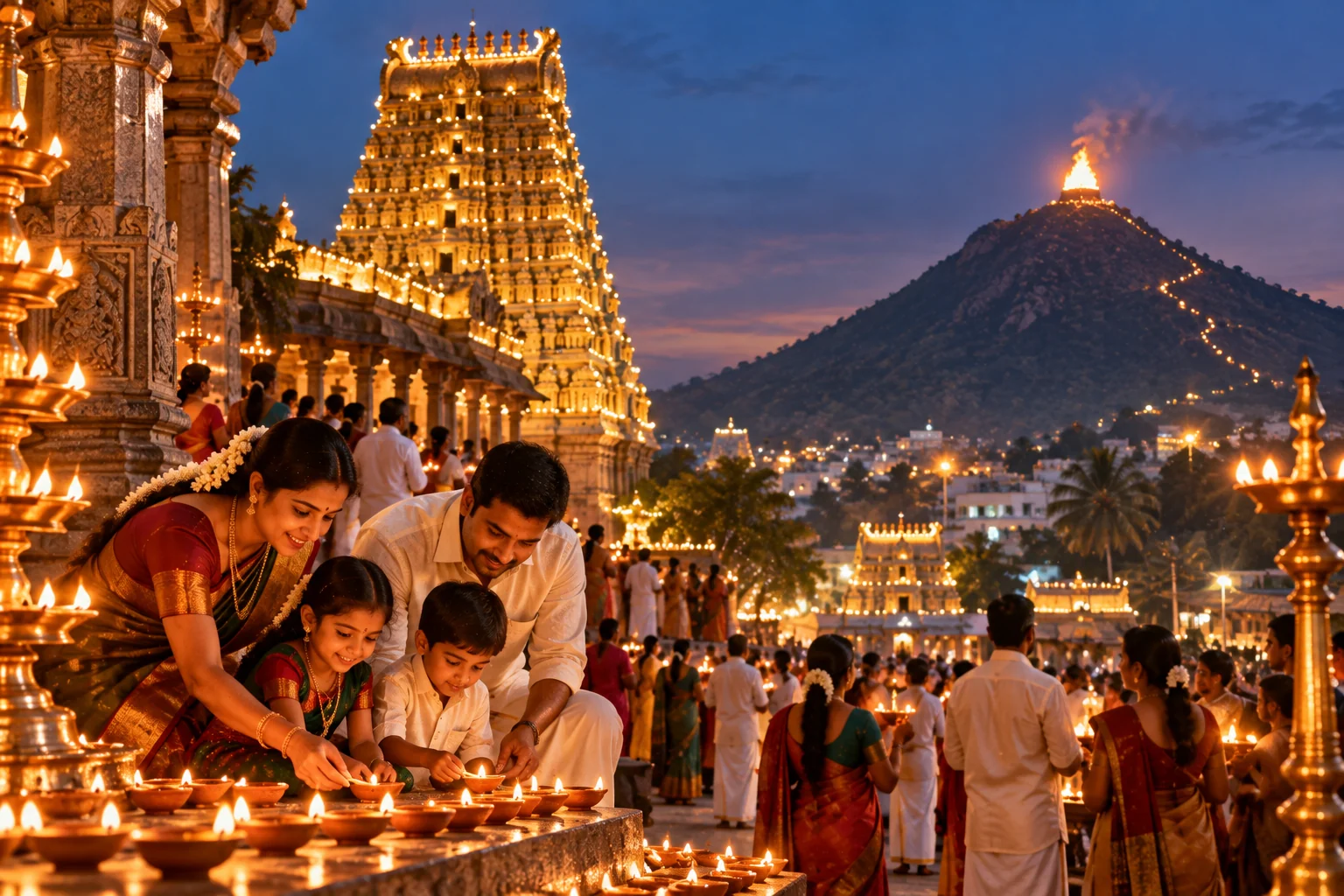
Kṛttikā in the Tamil month Kārttikai, the festival of lamps of the far south. Rows of lamps stand in every doorway, and a beacon is lit on the summit of Aruṇācala at Tiruvannamalai and burns for days.

When it falls

The day the Moon stands in Kṛttikā nakṣatra in the Tamil month Kārttikai, usually the day after the Kārttika full moon, in late November or December. The almanacs key it to the star, not the tithi.

The Phala almanac gives the exact day for your own city; the lunar and solar rules above are what it computes from.

The story

Brahmā and Viṣṇu argued about which of them was greater. Śiva settled it by becoming a column of fire with no top and no bottom, and told them to find its ends. Viṣṇu went down as a boar and Brahmā up as a swan; neither reached an end, and Viṣṇu admitted it while Brahmā lied.

The hill at Tiruvannamalai is held to be that column, cooled into rock. On this night a beacon is lit at the summit in a cauldron of ghee, and it burns for days and can be seen for miles.

The lamps in the doorways below are the same fire on a household scale — the oldest festival of lights in the Tamil country, older in the literature than Dīpāvali is there.

How the day is kept

  • Rows of clay lamps are set on every doorstep, wall and window from dusk, and kept burning through the evening.
  • At Tiruvannamalai the Mahādīpam is lit at the summit of Aruṇācala at nightfall, after the Bharaṇi Dīpam at dawn inside the temple.
  • Devotees walk the fourteen kilometres round the hill barefoot — the girivalam — through the night.
  • Pori uruṇṭai, balls of puffed rice in jaggery, and appam are made for the day.

More festivals of light

The Phala almanac shows this day where it falls for your own city — sunrise, tithi and all five limbs, anywhere on earth. See how the almanac works →