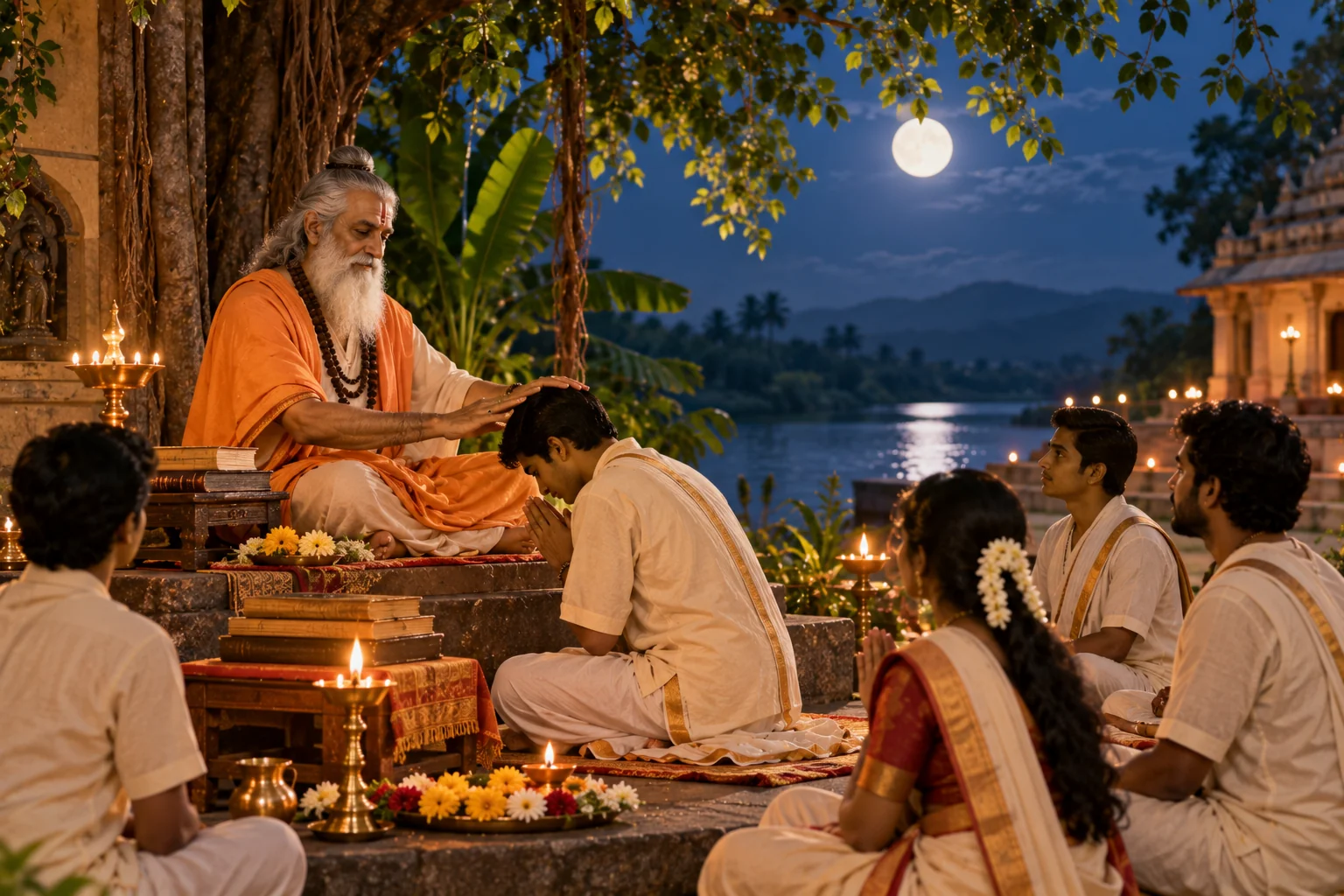
The full moon honouring one's teachers, from the sage Vyāsa down to whoever taught you to read. Students greet their gurus and begin new study.
When it falls
The full moon (pūrṇimā) of Āṣāḍha, in late June or July. It opens the four months of the monsoon retreat (cāturmāsya).
The Phala almanac gives the exact day for your own city; the lunar and solar rules above are what it computes from.
How Vedic Phala finds the date
Guru Pūrṇimā is the full moon of Āṣāḍha. Vedic Phala finds it by calculating the lunar month and pūrṇimā tithi at local sunrise. Since the Sun–Moon angle does not respect midnight, the full-moon tithi can cover portions of two civil dates, and a city in another time zone may print a different date. The app’s location is therefore part of the calculation rather than a display preference.
The day is also called Vyāsa Pūrṇimā for Kṛṣṇa Dvaipāyana Vyāsa, the teacher associated with arranging the Vedas and composing the Mahābhārata. Buddhist communities connect the same seasonal full moon with the Buddha’s first teaching and the opening of the rains retreat. Modern schools, āśrams, music lineages and families honour living teachers in their own forms. One full moon supports these related observances without making their teachings interchangeable.
A full-moon fast may end according to the local end of pūrṇimā, while a public programme may be moved to an evening or weekend. The app gives the almanac date; it does not relabel a convenience event as the lunar festival itself.
In a traditional teaching relationship the day is marked by guru-pūjā, an offering of flowers, cloth or dakṣiṇā, and by renewing the discipline received from the teacher. Performing arts lineages honour the person who transmitted the form; schools may honour ordinary teachers; monastic communities begin a season of settled study. These practices share gratitude but are not interchangeable institutions.
The rains-retreat connection explains the season. Travel becomes difficult with the monsoon, so teachers and students remain in one place and sustained instruction begins. The full moon is therefore both a remembrance of Vyāsa and a practical threshold in the annual life of a lineage.
A public event advertised as “Guru Purnima weekend” may be moved for attendance. The calculated Āṣāḍha full moon remains the ritual date, while the event listing answers a different practical question.
The story
Guru is the one who removes darkness: gu is darkness, ru the one who dispels it. The day is Vyāsa's birthday, the sage who arranged the Vedas into four, composed the Mahābhārata and the Purāṇas, and stands at the head of every line of teachers.
Buddhists keep the same full moon for the Buddha's first sermon at Sārnāth, given to the five ascetics who became his first students. Jains keep it as the day Mahāvīra accepted Gautama Swāmī as his first disciple.
Wandering monks stopped travelling for the rains from today and stayed in one place to teach; the students who came to them gave the day its shape.
How the day is kept
Students visit their teachers, of any subject, with flowers, fruit and a gift, and touch their feet.
Guru pūjā is performed in āśramas and temples, with the image or sandals (pādukā) of the lineage's founding teacher.
New study is begun: a first lesson of music, a first verse of a text.
Farmers mark the start of the sowing season; the moon is the one Indian astronomers used to fix the monsoon.
Watch
Videos from YouTube, each credited to its channel. Tap one to play it here, or open it on YouTube.
The storyWhat Guru Pūrṇimā isThe day of Vyāsa and of every teacher, explained: why the full moon of Āṣāḍha, and what a student does on it.Courtesy of The Sanskrit Channel · Watch on YouTube
CelebrationsGuru Pūrṇimā at IshaThe Guru Pūrṇimā gathering at the Isha Yoga Center in Coimbatore, one of the largest in the south.Courtesy of Sadhguru Darshan · Watch on YouTube
CelebrationsGuru Pūrṇimā at a Vṛndāvana āśrama · In HindiThe celebration at Premanand Maharaj's āśrama in Vṛndāvana: the guru pūjā, the kīrtan, the crowd of students.Courtesy of Shri Hit Radha Kripa · Watch on YouTube