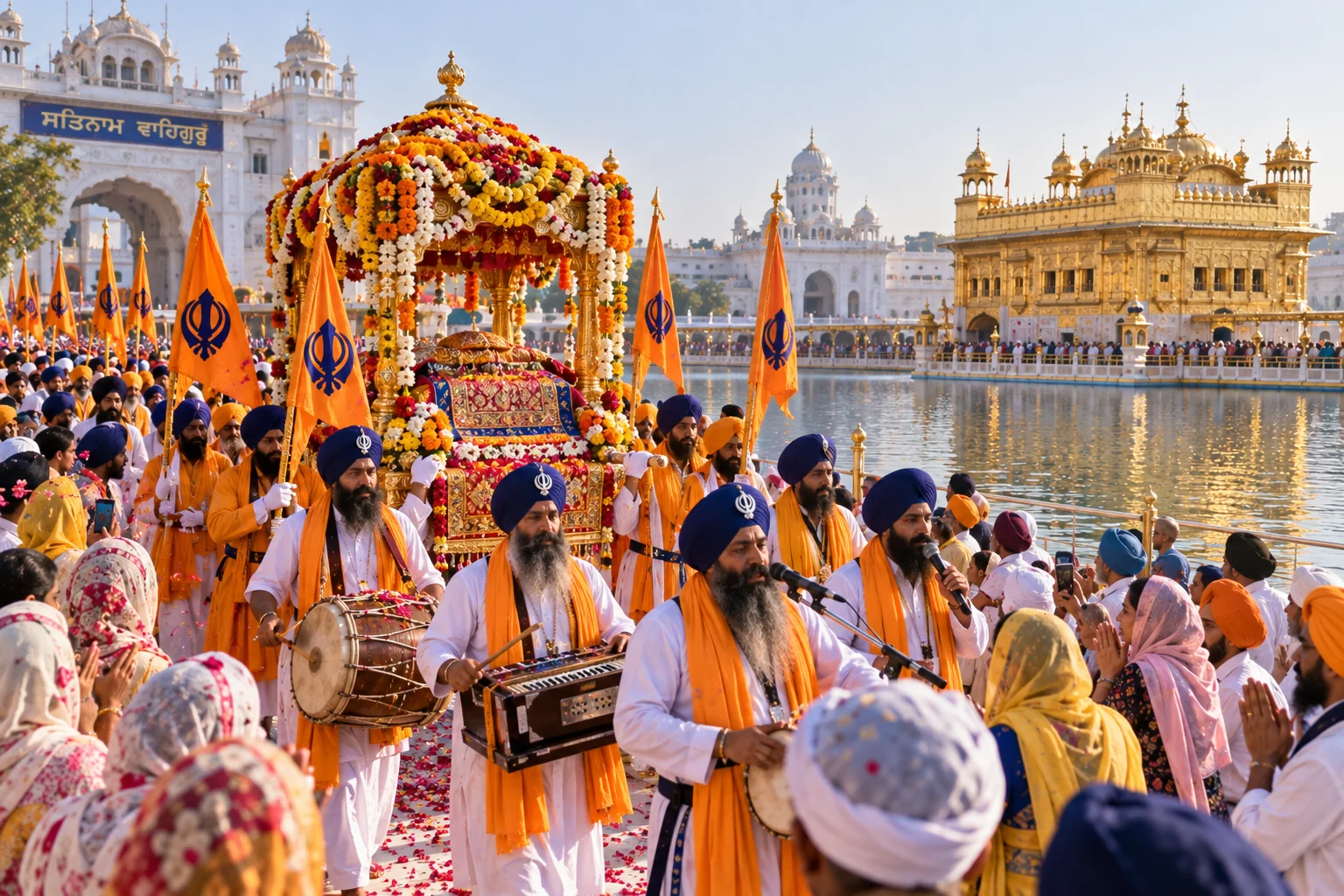
The birth of Gurū Nānak, first of the ten Sikh Gurus, kept on the Kārttika full moon. The Gurū Granth Sāhib is read end to end over the preceding two days, and langar is served to all comers.
How Vedic Phala finds the date
Guru Nānak Gurpurab is generally observed on the Kārttika full moon, which Vedic Phala calculates from the local lunar month and pūrṇimā tithi at sunrise. Sikh historical calendars have debated the birth date and calendar basis, and some sources give a date in April. The widely observed November gurpurab remains the convention used by the app and by most public calendars.
The Akhaṇḍ Pāṭh begins about two days before so that the continuous reading of the Gurū Granth Sāhib concludes on the festival. A nagar kīrtan commonly takes place on the preceding day, and the gurpurab itself begins before dawn with hymns. Those events explain why a gurdwara programme spans several civil dates even though a calendar shows one festival marker.
Pūrṇimā can cross a local date boundary, but a gurdwara committee’s announced programme is the practical authority for attendance. The app supplies the conventional lunar anchor and the reader’s local calendar context; it does not overwrite the institutional calendar or the historical discussion.
The story
Nānak was born at Talwaṇḍī, now Nankana Sahib in Pakistan, into a Hindu family in a country ruled by Muslims. He worked as an accountant, married, had two sons, and at about thirty went to bathe in a river and did not come out for three days. When he returned he said: there is no Hindu, there is no Muslim.
He spent the next quarter century walking — to Mecca, to Baghdad, to Assam, to Sri Lanka — with a Muslim companion, Mardānā, playing the rabāb while he sang. What he taught fits in three lines: remember the name, earn your living honestly, share what you have.
He settled at Kartarpur, farmed, and appointed a successor from among his followers rather than from his family. Nine Gurus followed him, and the tenth put the succession into the scripture itself.