← All festivals

The birth of the tenth Sikh Guru, who founded the Khālsā at Anandpur, lost his four sons and his mother to the Mughal wars, and ended the line of living Gurus by giving the succession to the scripture itself.

When it falls

The seventh lunar day of the bright half of Pauṣa, in late December or January. Guru Gobind Singh was born at Patna in 1666.

The Phala almanac gives the exact day for your own city; the lunar and solar rules above are what it computes from.

The story

He became the tenth Guru at nine, when his father Guru Tegh Bahadur was executed in Delhi for defending the right of Kashmiri Hindus to their own religion.

At Anandpur in 1699 he asked a crowd for a head. Five men came forward one after another; he took them behind a tent and returned with a sword each time, then brought all five out alive. Those five were the first of the Khālsā, and he then asked them to initiate him in turn.

He lost all four of his sons and his mother to the Mughal wars — two in battle, two bricked into a wall at Sirhind aged nine and seven. He ended the line of living Gurus by giving the succession to the Gurū Granth Sāhib itself.

How the day is kept

  • An unbroken forty-eight-hour reading of the Gurū Granth Sāhib in the days before, ending on the morning itself.
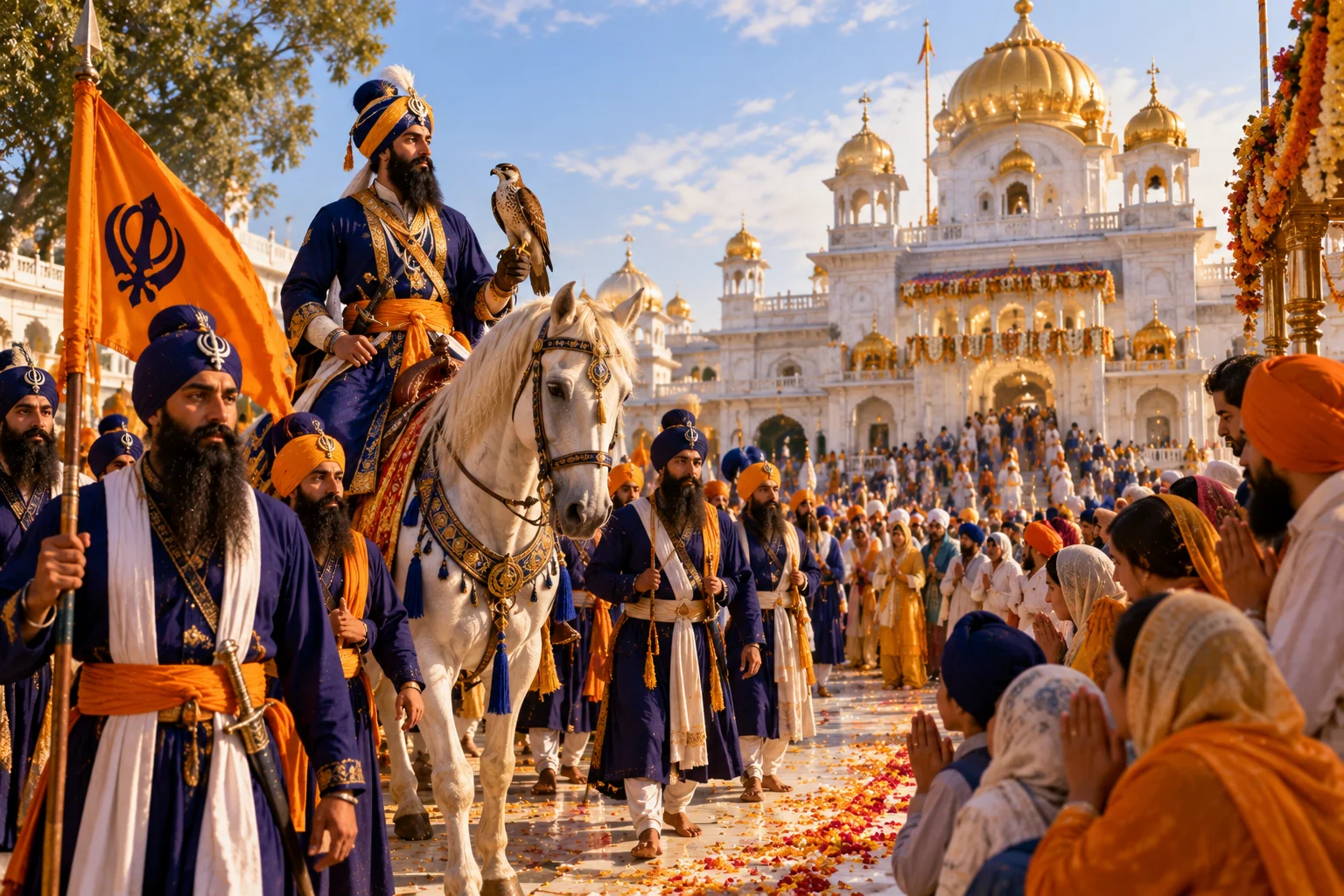
  • Nagar Kīrtan through the streets, often with gatkā, the Sikh martial art, demonstrated along the route.
  • Langar all day, and at Patna Sahib, his birthplace, and Anandpur Sahib the gatherings run to hundreds of thousands.
  • Talks on the Zafarnāmā, the letter he wrote to Aurangzeb after losing everything, are a fixture of the day.

More birthdays of gods, saints and teachers

The Phala almanac shows this day where it falls for your own city — sunrise, tithi and all five limbs, anywhere on earth. See how the almanac works →