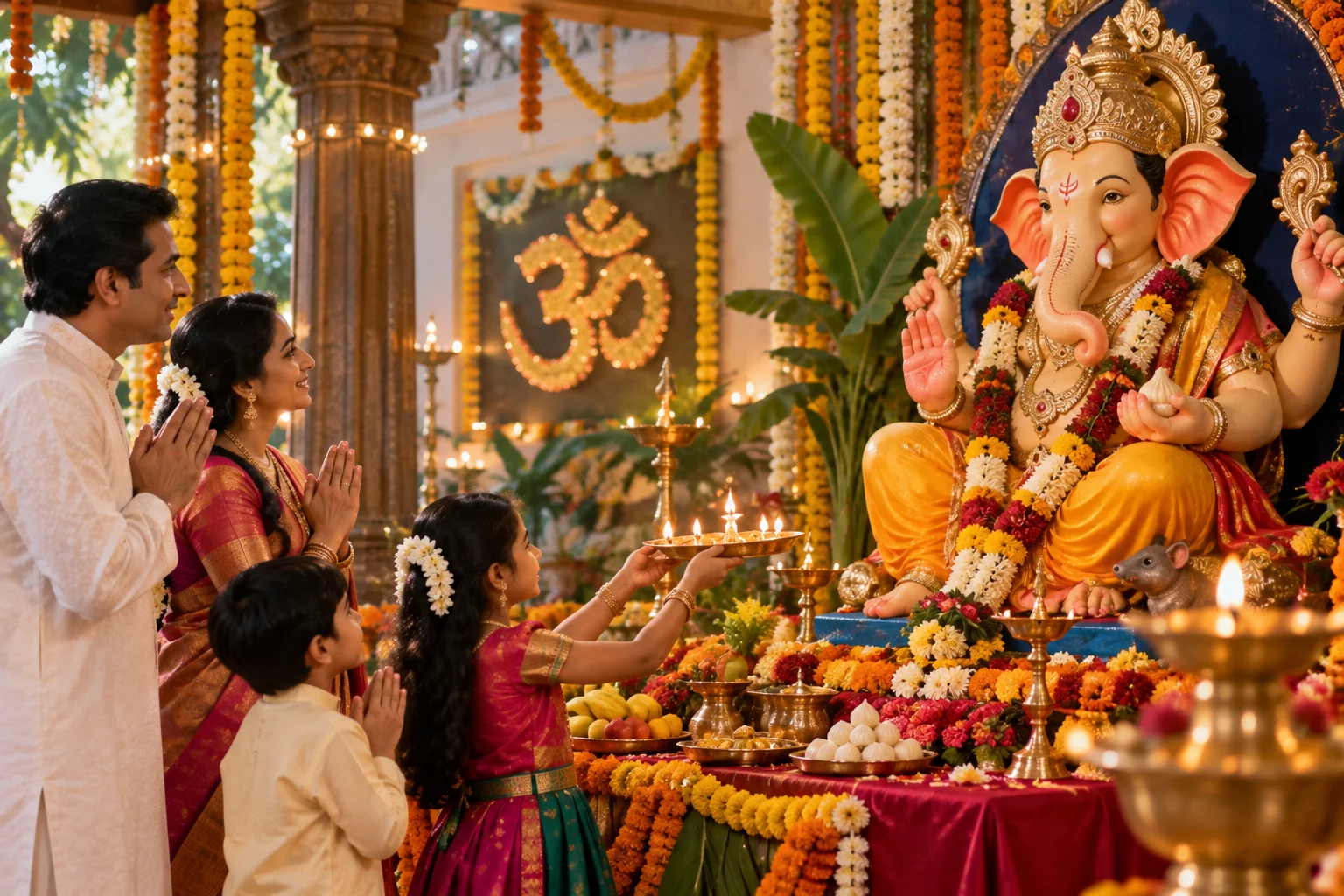
Gaṇeśa's festival, the fourth day of Bhādrapada. Clay images are installed at home, offered modaka (sweet dumplings), and immersed in water days later.
How Vedic Phala finds the date
Gaṇeśa Caturthī is located from Bhādrapada śukla caturthī: the fourth tithi of the waxing half of the lunar month. Vedic Phala computes the tithi at the reader’s sunrise instead of storing “a September holiday.” Since the Moon’s speed varies, caturthī is not exactly twenty-four hours and can cross two civil dates. A city west of India can therefore meet a different sunrise boundary even though the astronomical instant is the same. The app uses the city and time zone attached to the almanac to make that conversion.
The first day and the immersion are separate calendar questions. A household may keep the image for one and a half, three, five, seven or ten days; public celebrations normally close on Ananta Caturdaśī, the waxing fourteenth. The app lists that observance independently rather than assuming every image stays ten days. Maharashtra’s Gaṇeśotsav, Karnataka’s Gauri–Gaṇeśa sequence and Telugu Vināyaka Cavithi share the caturthī anchor but differ in household rites, names and duration. Those differences are traditions around the date, not evidence that one calendar has computed the Moon incorrectly.
The story
Gaṇeśa is the elephant-headed son of Pārvatī and Śiva, the remover of obstacles, and the god invoked at the start of every undertaking. His mother shaped him from the paste of her own body to guard her door; Śiva, not knowing him, struck off his head, and restored him with the head of the first creature found, an elephant.
Home worship of Gaṇeśa on this day is old, but the public festival is a nineteenth-century creation. In 1893 Lokamānya Tilak turned the household rite into a neighbourhood one in Pune, giving people a lawful reason to gather in large numbers under British rule. The paṇḍāl (festival tent), the ten days of music and the immersion procession all date from then.
Mumbai's Lālbāghchā Rājā, installed since 1934, draws over a million visitors in its ten days; the Ganeshotsav is the city's largest event of the year.