← All festivals

Varalakṣmī Vratam

Varalakṣmī Vratam

The Friday before the Śrāvaṇa full moon, kept by married women for Lakṣmī as Varalakṣmī (meaning 'the boon-giving Lakṣmī'). A decorated pot stands for the goddess, and the thread tied at the end of the pūjā is worn until it wears through.

When it falls

The Friday before the full moon of Śrāvaṇa, in late July or August. Where the full moon itself falls on a Friday, the vrata belongs to the Friday before it.

The Phala almanac gives the exact day for your own city; the lunar and solar rules above are what it computes from.

The story

Varalakṣmī means 'the Lakṣmī who gives boons'. The Skanda Purāṇa has Śiva give the vrata to Pārvatī, and tells it through Cāruma, a woman of Magadha who kept it and whose house filled with gold — and who then taught it to her neighbours rather than keeping the method to herself.

The eight Lakṣmīs are invoked together on the day: wealth, grain, courage, victory, offspring, knowledge, and the two that make the others usable — the Lakṣmī of the beginning and the Lakṣmī of what lasts.

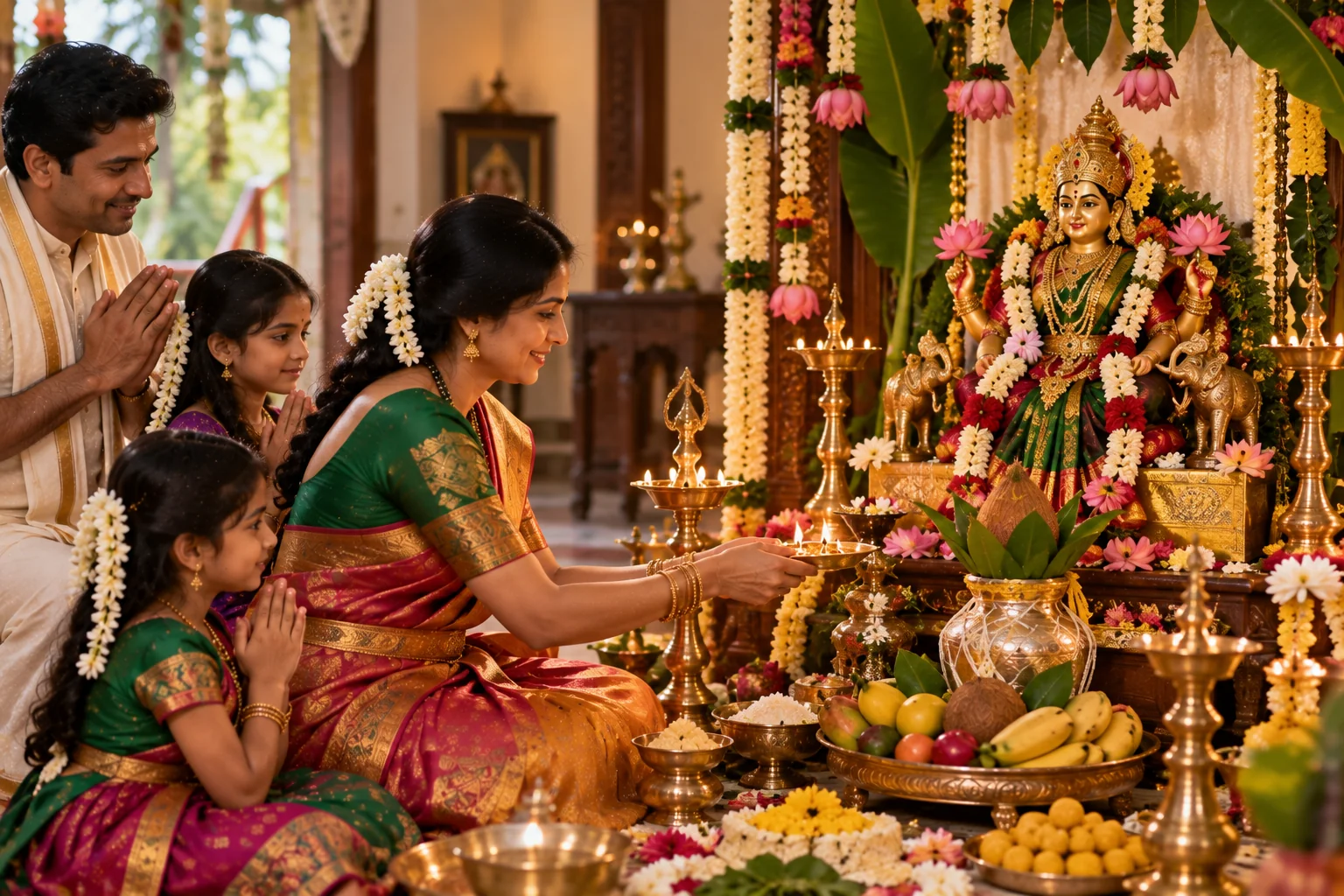
It is a household festival with no temple at its centre. The goddess is invited into the house, seated in a pot, treated as a guest for a day, and thanked.

How the day is kept

  • A brass or clay pot (kalaśa) is filled with rice or water, draped in a sari, hung with jewellery and topped with a coconut and mango leaves; a face of Lakṣmī is fixed to the front.
  • Nine or eleven strands of thread are tied with turmeric and worn on the right wrist after the pūjā; the previous year's thread is taken off first.
  • Sweet offerings are made in nines — nine kinds of snack in Andhra and Telangana, payasam and kozhukattai in Tamil Nadu — and neighbours are called in to be given tāmbūlam, betel leaf with turmeric and a blouse piece.
  • It is kept largely by married women, in Andhra Pradesh, Telangana, Karnataka and Tamil Nadu, and the invitation list is the point as much as the pūjā.

More fasts and vigils

The Phala almanac shows this day where it falls for your own city — sunrise, tithi and all five limbs, anywhere on earth. See how the almanac works →