
← All festivals

Vaṭa Sāvitrī Vrata

Vaṭa Sāvitrī Vrata

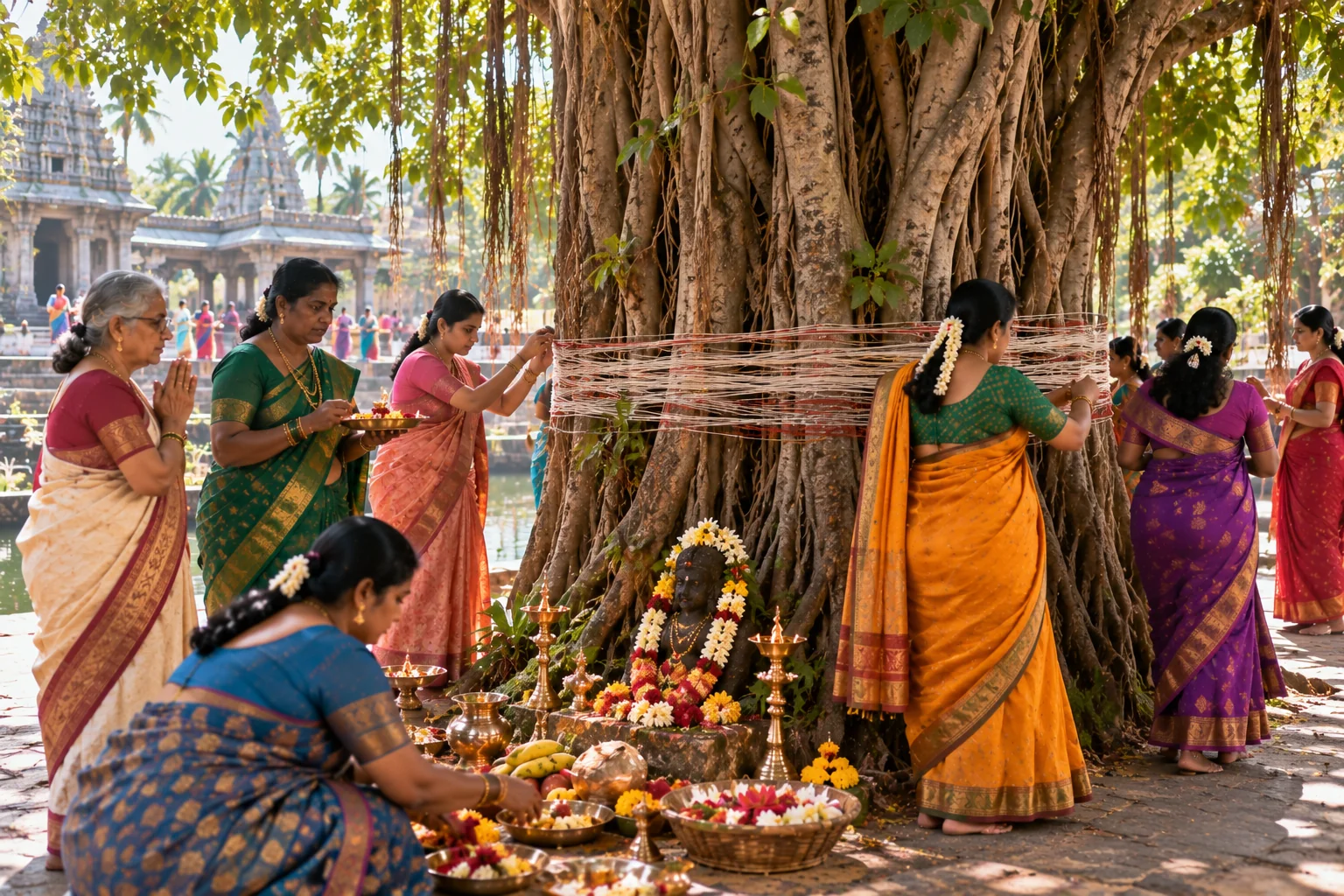
Married women fast and circle a banyan (vaṭa) tree with thread, recalling Sāvitrī, who argued Yama out of her husband's life beneath one. Kept on the Jyeṣṭha new moon in the Deccan and the north; Maharashtra and Gujarat keep it on the full moon a fortnight later as Vaṭa Pūrṇimā.

When it falls

The new moon (amāvāsyā) of Jyeṣṭha in the Deccan, the north and Odisha; the full moon of Jyeṣṭha, a fortnight later, in Maharashtra and Gujarat, where it is called Vaṭa Pūrṇimā. Late May or June either way.

The Phala almanac gives the exact day for your own city; the lunar and solar rules above are what it computes from.

The story

Sāvitrī chose Satyavān knowing what the sage Nārada had told her: that he had one year to live. She married him anyway, kept count of the days, and fasted for three before the last one.

When Yama came for him she followed. Yama told her to turn back; she kept walking and kept talking, and he offered her boons to be rid of her — anything but her husband's life. She asked for her father-in-law's sight, his kingdom, sons for her own father, and then a hundred sons for herself. Yama granted it, and she pointed out that she could not have sons without a husband. He returned Satyavān.

The story is in the Mahābhārata, told to Yudhiṣṭhira, and it is an argument rather than a miracle: she does not plead, she reasons Yama into a corner he agreed to walk into.

The banyan is in it because Satyavān died under one and was revived under it. The tree lives for centuries and sends down roots that become trunks, so it stands for a life that does not end where it seems to.

How the day is kept

  • Married women fast, many of them without water, and wear the red and gold of a bride.
  • A banyan tree is watered, marked with vermilion and circled while raw cotton thread is wound round the trunk — seven times, or one hundred and eight where the count is kept strictly.
  • The story of Sāvitrī and Satyavān is read aloud at the tree, often by an older woman with the younger ones listening.
  • Mango, jackfruit and soaked gram are offered and shared, and elders are touched at the feet for their blessing.
  • Where no banyan is near, a branch in a pot stands in for it — increasingly the city version of the day.

More fasts and vigils

The Phala almanac shows this day where it falls for your own city — sunrise, tithi and all five limbs, anywhere on earth. See how the almanac works →