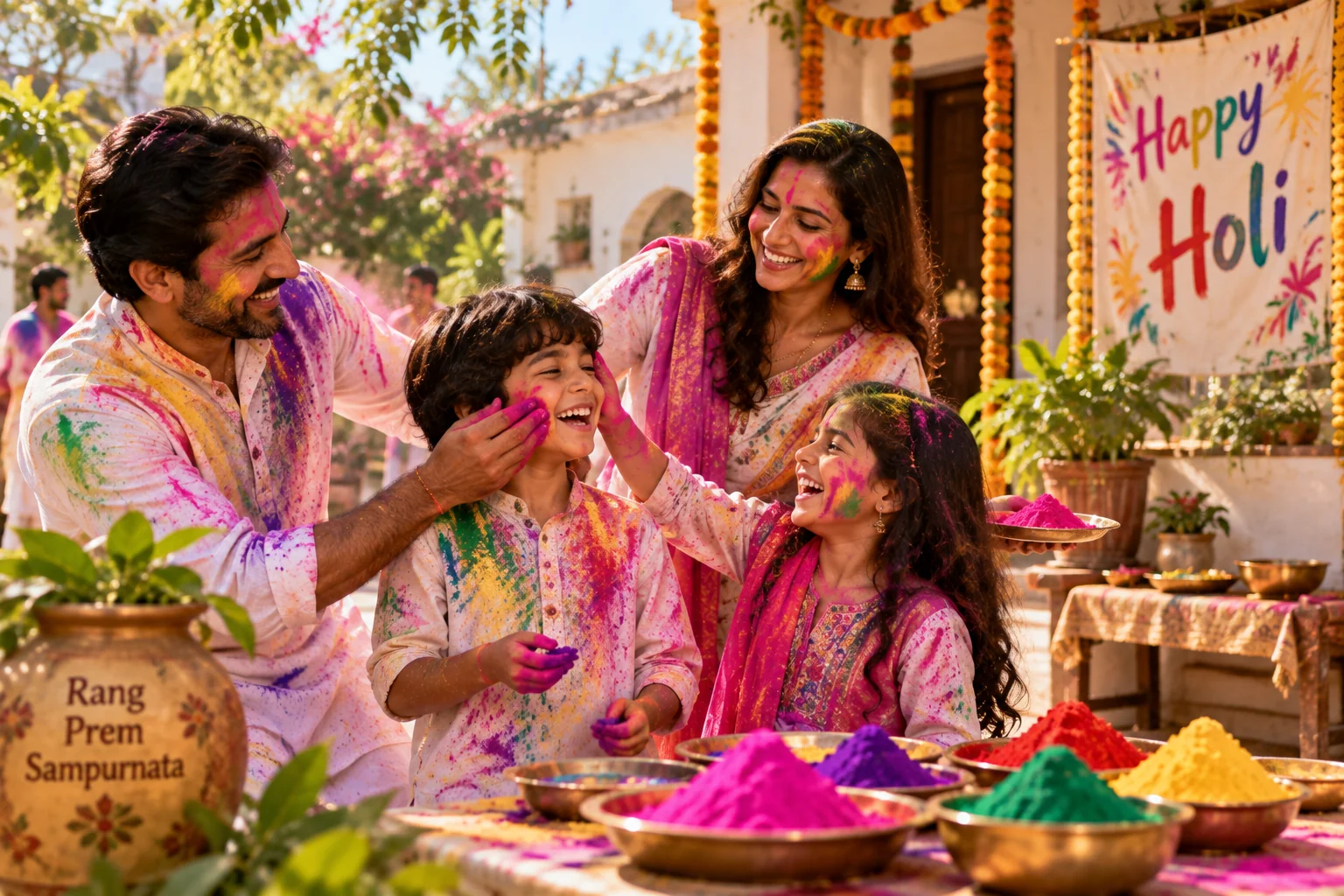
The festival of colours on the Phālguna full moon. The bonfire the night before burns Holikā; the morning after, colour lands on everyone equally.
How Vedic Phala finds the date
The app finds Holī from the Phālguna full moon rather than from a Gregorian anniversary. Its pañcāṅga calculates the Sun–Moon separation for the reader’s location, identifies the pūrṇimā tithi at local sunrise, and places the festival in the corresponding lunar month. Because lunar days do not begin at midnight, the full-moon tithi may span the evening of one civil date and the morning of the next. That is why the bonfire and the colour celebration carry different names and can appear on adjacent dates in calendars.
Holikā Dahan belongs to the full-moon evening, while Raṅgwālī Holī is the following morning. A printed list that names only “Holi” can hide that two-part structure. Braj observances begin earlier still: Barsānā and Nandgaon schedule Lāṭhmār Holī within a longer local cycle, Bengal keeps Dol Jātrā, and Manipur’s Yaoshang runs for several days. Vedic Phala marks the shared lunar anchor. Temple schedules, local prohibitions on the bonfire period, and municipal celebration dates remain local decisions rather than extra universal tithis.
The story
The demon king Hiraṇyakaśipu could not bear that his son Prahlāda worshipped Viṣṇu. His sister Holikā had a boon that fire could not touch her, so she sat in a pyre with the boy on her lap. The boon held only when she entered fire alone: she burned, Prahlāda walked out unharmed, and the bonfire is hers.
The colours are Kṛṣṇa's. Dark-skinned and jealous of fair Rādhā, he was told by his mother to colour her face whatever he liked, and the villages of Braj have thrown colour at one another ever since. At Barsānā the women drive the men of Nandgaon away with sticks (Lāṭhmār Holī) a week before the rest of India begins.
For one morning the ordinary lines of caste, age, sex and rank do not hold; anyone may colour anyone. Burā na māno, Holī hai: don't mind, it's Holī.