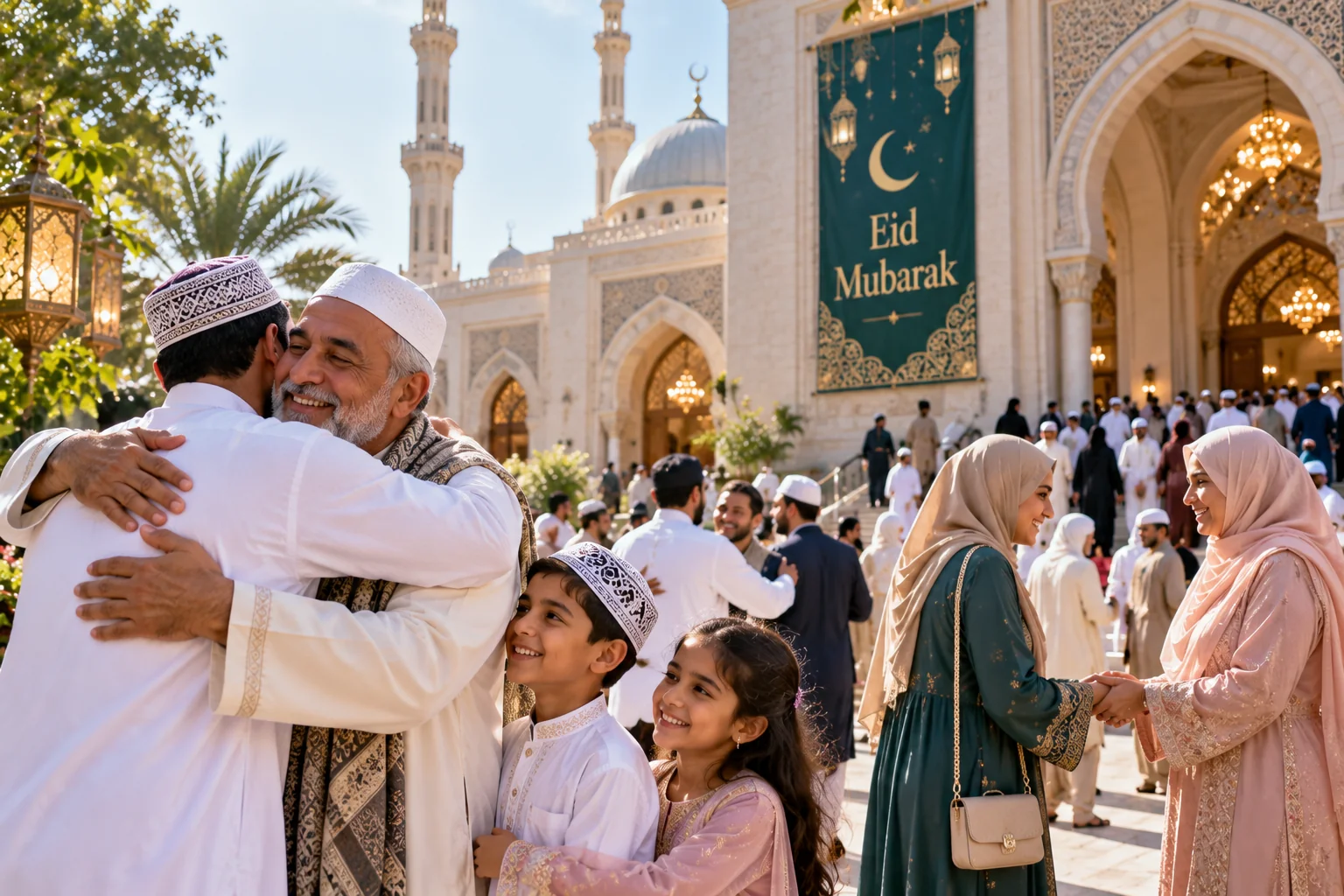
The festival breaking Ramadan's fast: new clothes, charity given before the prayer, and sweets — the sweet Eid.
How Vedic Phala finds the date
Eid al-Fitr begins with the first day of Shawwāl, immediately after Ramadan. Vedic Phala’s calendar converts the civil date through its Hijri calendar layer, but actual religious observance may depend on a local or national crescent-sighting authority. An astronomical or tabular calendar can predict the likely date; it cannot claim that every community will accept the crescent on the same evening. That is why neighbouring countries, and sometimes communities in one country, can begin Eid on different civil dates.
The day starts after the final Ramadan sunset, though the congregational prayer is held the next morning. Zakāt al-fiṭr is given before that prayer, then families visit, eat and wear new clothes. The app’s date is useful for planning and for placing the festival in the annual calendar. A mosque announcement remains decisive for a reader whose practice follows witnessed sighting.
Time zones do not merely translate one global sighting instant. Visibility depends on the Moon’s age, elongation, altitude and local horizon, while legal and religious authorities use different acceptance rules. The site therefore explains the basis instead of presenting disagreement as a calculation failure.
The story
Fiṭr is the breaking of the fast. After the twenty-nine or thirty days of Ramaḍān the crescent is looked for at sunset, and the moment it is seen the month of fasting is over and the festival begins. Because the sighting decides it, neighbouring countries sometimes keep Eid a day apart.
The Prophet Muḥammad established the two Eids at Medina in the second year after the migration, and this one carries the charity of the fast: before the morning prayer every family gives zakāt al-fiṭr, a fixed measure of food or its price for each member, so that the poor keep Eid with everyone else.
In South Asia it is the sweet Eid (mīṭhī Eid), from the sevaiyāṅ (vermicelli) that every household cooks; across Indonesia and Malaysia it is Lebaran, the week when the cities empty as everyone returns to their home village (mudik).