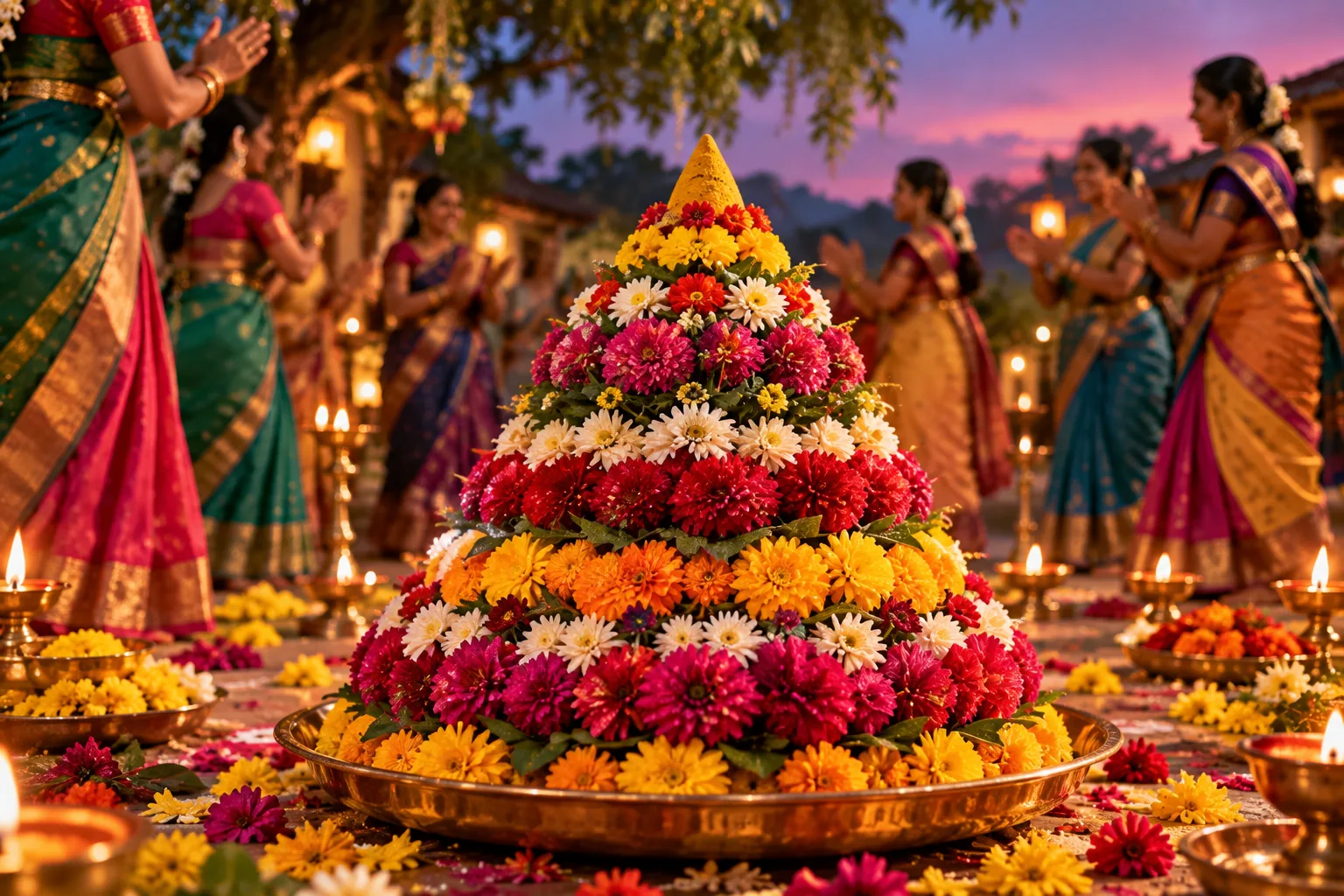
Telangana's nine days of flower stacks for Gaurī, built up in conical layers and carried out at dusk for the women to circle and sing around. It opens on the Mahālaya amāvāsyā and closes on Durgāṣṭamī with Saddula Bathukamma, when the stacks are floated away on the nearest water.
When it falls
Nine days from the Mahālaya amāvāsyā, the ancestors’ new moon, to Durgāṣṭamī, in late September or October. It opens the day before Navarātri and closes two days before it, so the two run alongside each other without sharing a calendar.
The Phala almanac gives the exact day for your own city; the lunar and solar rules above are what it computes from.
The story
Bathukamma means ‘come alive, mother’. The stack itself is the goddess: seasonal flowers packed in widening rings on a brass plate, tallest at the centre, with a cone of turmeric standing for Gaurī set on the top. It is built at home in the morning and carried out at dusk.
The season is what makes it possible. The monsoon has just ended, the tanks are full, and the uncultivated ground is thick with gunugu (celosia), tangedu (tanner’s cassia), marigold and lotus. These are flowers nobody plants and nobody sells; the festival is made of what the rain left behind.
Each of the nine days carries its own name and its own offering, from Engili Pūla Bathukamma on the first to Saddula Bathukamma on the ninth and largest. Telangana made it a state festival in 2014.
At the table
Maleeda, roṭī crumbled into jaggery and ghee, and sattupiṇḍi, roasted flour with jaggery. The day-named offerings are food too: soaked rice, moong dal with jaggery, sesame, and on the last day the five saddula rices — curd, tamarind, lemon, coconut and sesame.